
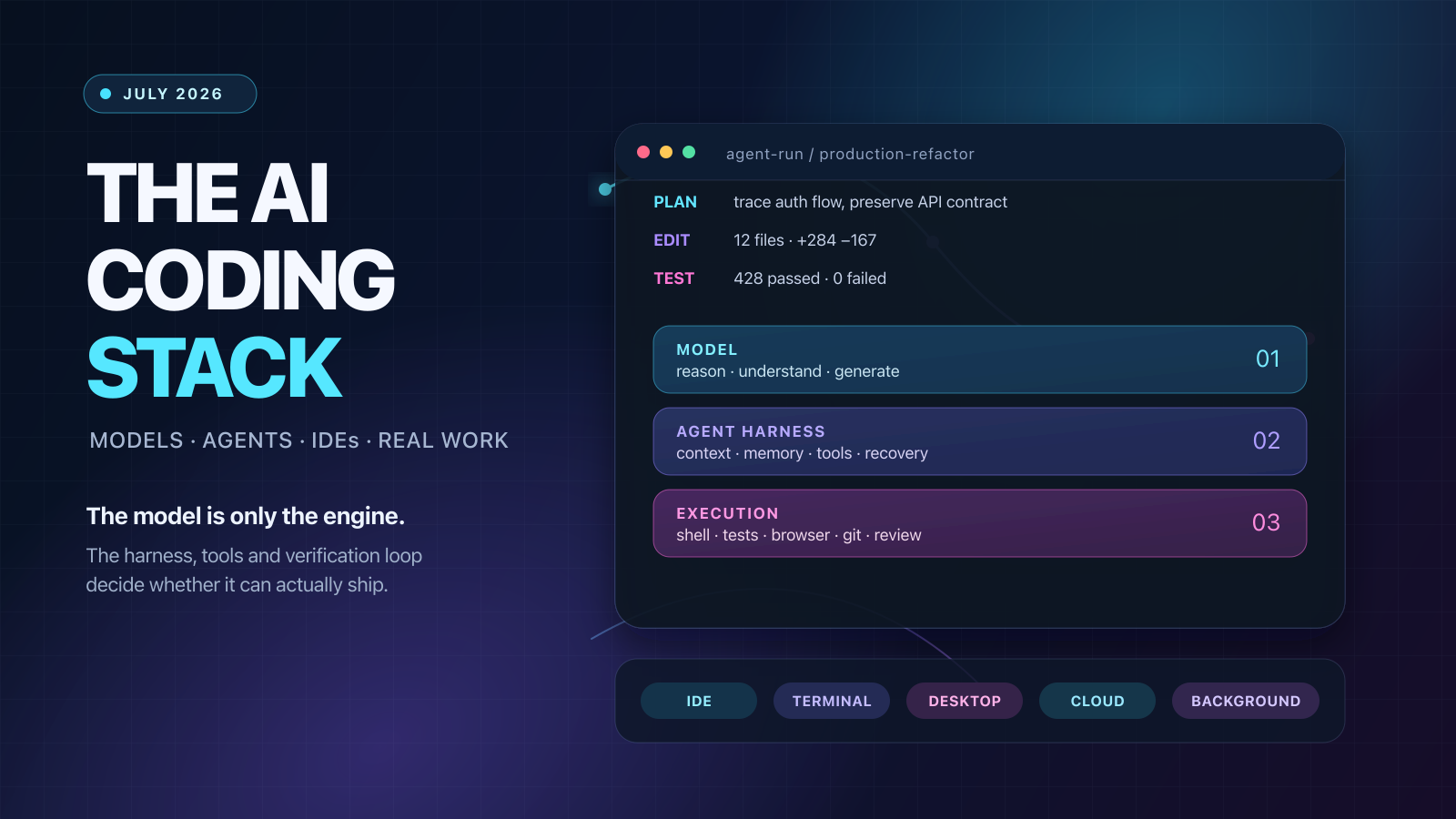
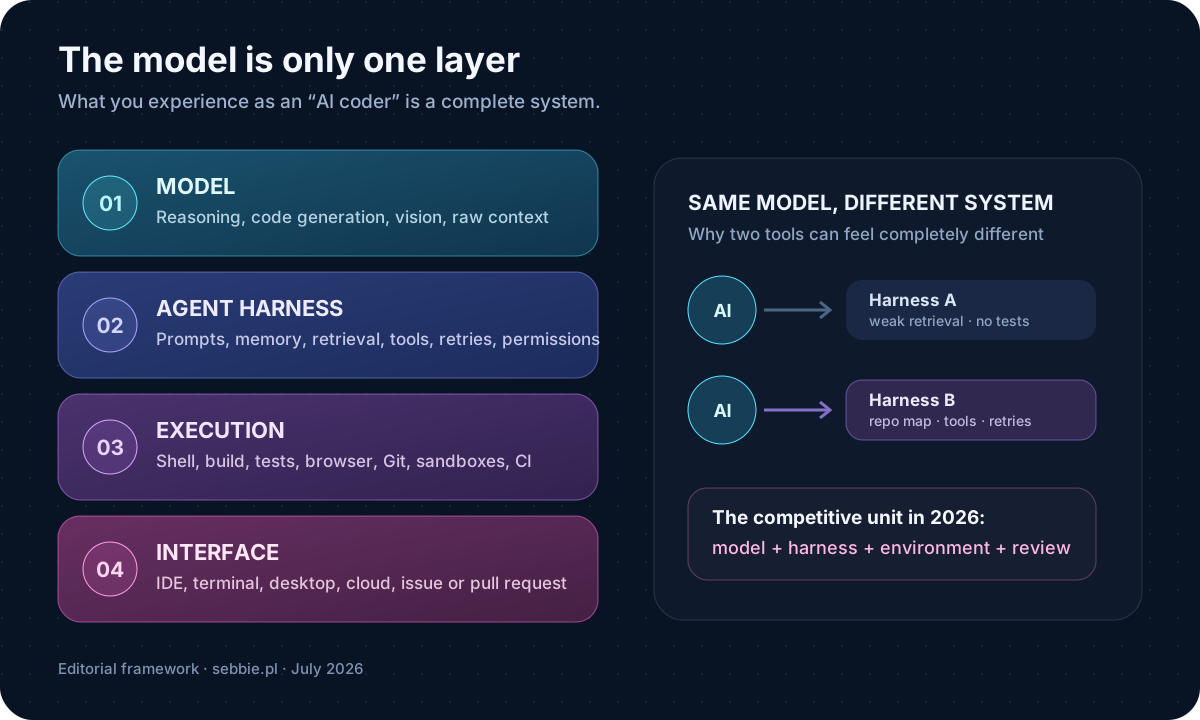
Choosing among the best AI coding tools in 2026 used to mean choosing a model. That is now the wrong abstraction. The same model can feel brilliant in one product and clumsy in another because the surrounding system decides what it can see, what it can execute, how it recovers from failure, and how safely you can review the result.
Three names on last month's shortlist are already stale.
Windsurf became Devin Desktop. Google moved individual developers from Gemini Code Assist and Gemini CLI to Antigravity. AWS is retiring the Amazon Q Developer IDE experience in favor of Kiro. Meanwhile, GPT-5.6 became generally available on July 9 after a limited preview, Claude Fable 5 took Anthropic's top slot, and Grok 4.5 arrived on July 8.
The short version: the best AI coding tools in 2026
1. The model landscape: what is actually current?
The frontier is moving fast enough that a model list needs a date stamp. More importantly, there is no single "best coding model" independent of the task. A fast model inside a disciplined agent loop can outperform a smarter model that receives poor context, cannot run tests or loses the thread after its first failed patch.
OpenAI: GPT-5.6 is now the default family
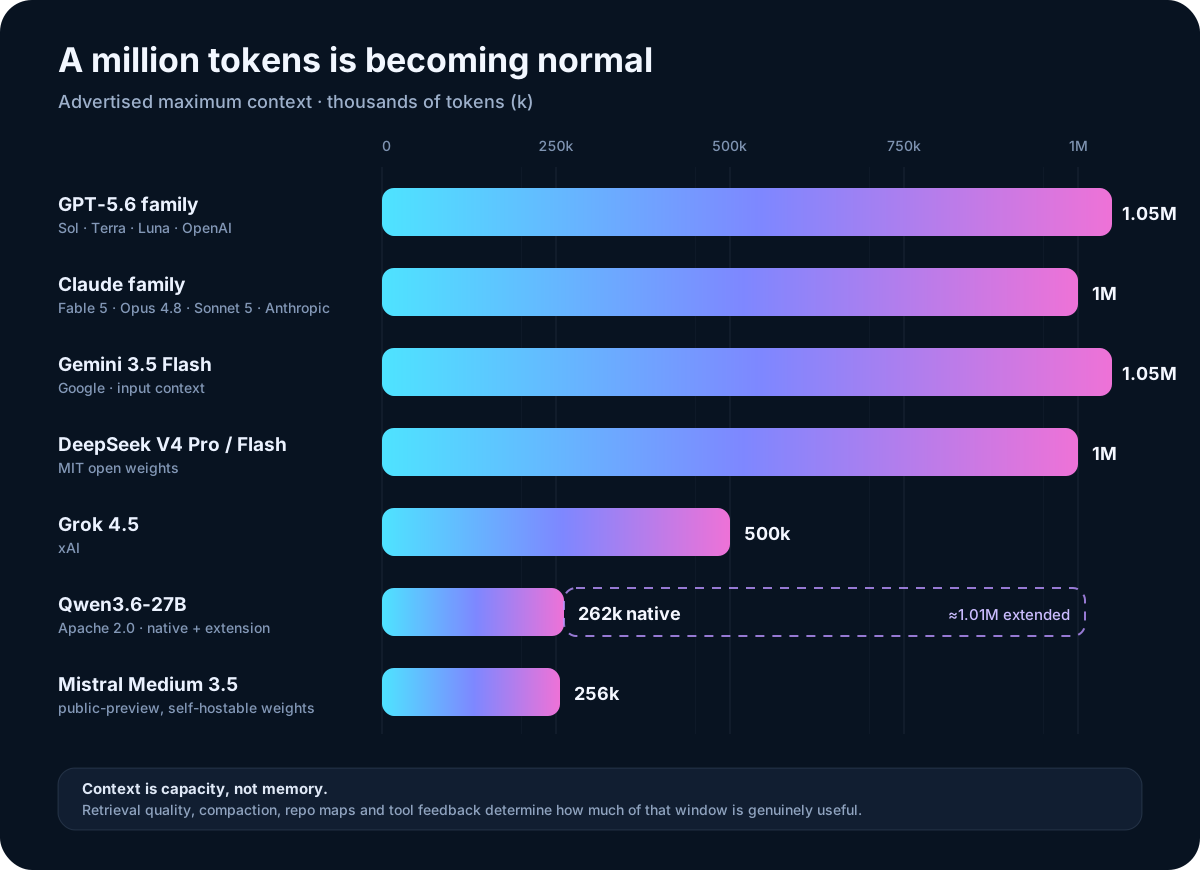
GPT-5.6 became generally available on July 9 across ChatGPT, Codex and the API. Sol is the flagship and OpenAI's current best coding model; Terra balances capability and cost for everyday work; Luna is the fastest, most affordable tier. The family offers roughly 1.05 million tokens of context and up to 128K output, so GPT-5.5 is now the previous-generation reference rather than the default recommendation.
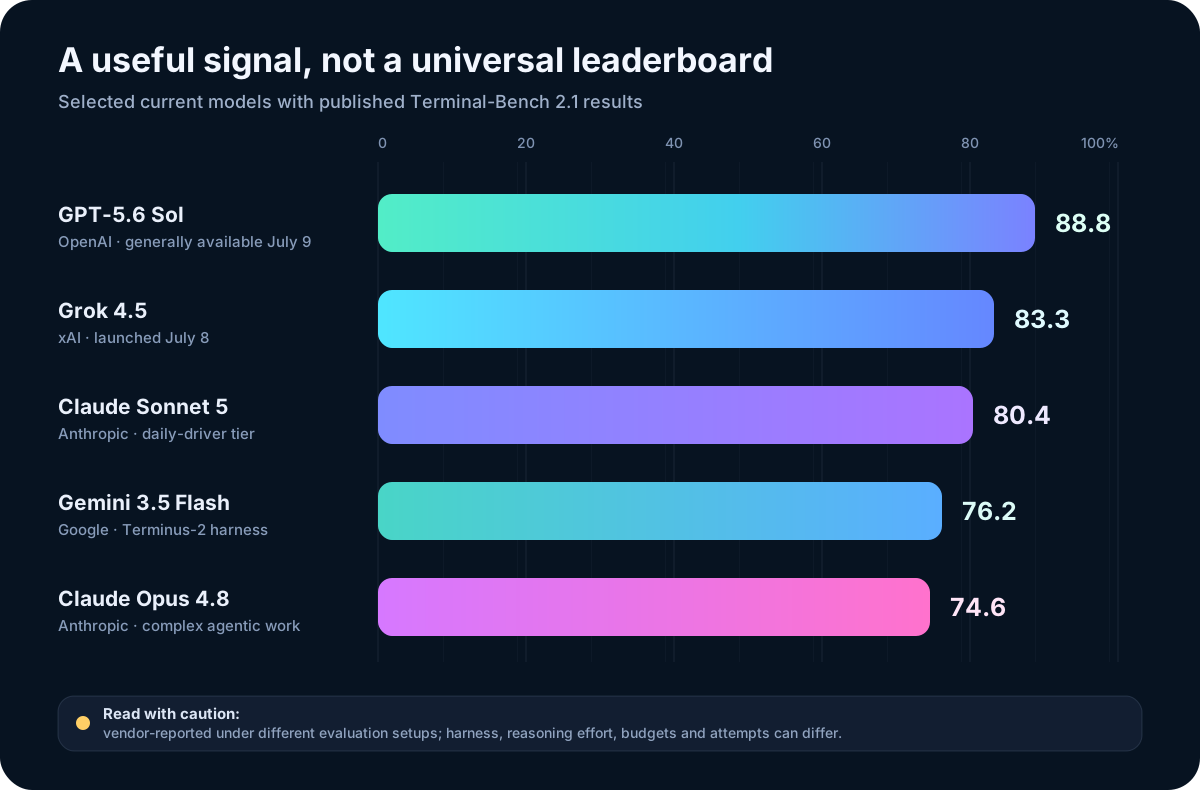
Sol also introduces max reasoning and an ultra mode that coordinates parallel agents for the most demanding work. OpenAI reports 88.8% on Terminal-Bench 2.1 for Sol and 91.9% for Sol Ultra. The older GPT-5.3-Codex remains a dedicated coding specialist and Codex-Spark remains the low-latency option, but the GPT-5.6 family is now the center of the current stack.
Anthropic: Fable at the top, Sonnet for daily work
Claude Fable 5 is Anthropic's most capable widely released model for long-running agents and difficult coding problems. Claude Opus 4.8 remains a documented starting choice for complex agentic coding, while Claude Sonnet 5 is the faster daily-driver tier. All three advertise a one-million-token context window and up to 128K output.
The practical advantage is not only the model family. Claude Code wraps those models in a mature terminal agent with memory, hooks, skills, MCP, subagents and multiple execution surfaces. That combination is why "Claude" can feel different in Claude Code than it does in a generic chat box.
Google: Gemini 3.5 Flash is stable; 3.5 Pro is not listed yet
Gemini 3.5 Flash is Google's current stable model with a 1,048,576-token input window. Gemini 3.1 Pro Preview remains available for more deliberate work; Google's model pages do not yet present Gemini 3.5 Pro as generally available. For individual developers, the more consequential shift is the tool around the model: Google now directs them to the Antigravity IDE and CLI rather than the old consumer Gemini Code Assist flow.
xAI: Grok 4.5 enters the coding conversation
Grok 4.5 launched on July 8 with a 500K context window and strong vendor-reported coding-agent results. It is now the default model in Grok Build. The launch notice also says EU availability is expected in mid-July, which matters if you are reading this from Europe. It is an interesting new option, but not yet the universal default that a benchmark bar might suggest.
Open weights: no longer just the compromise tier
DeepSeek V4 Pro and V4 Flash combine MIT-licensed weights, a one-million-token window and OpenAI- and Anthropic-compatible hosted APIs. Pro is the heavier agentic model; Flash is the efficient default and currently sits behind the familiar deepseek-chat and deepseek-reasoner aliases, which DeepSeek plans to retire on July 24.
Qwen3.6-27B is a particularly attractive Apache 2.0 option: 262K native context, officially extendable to roughly one million tokens, multimodal input and a size that is more approachable than trillion-parameter mixtures. Mistral Medium 3.5 is a public-preview, self-hostable model and has become the default in Mistral Vibe, replacing Devstral 2 in the hosted coding role. Its modified MIT license restricts use of the weights by companies whose consolidated monthly revenue exceeded $20 million in the previous month unless they obtain a commercial license or use Mistral's hosted service. For a genuinely permissive local Mistral option, Devstral Small 2 remains relevant under Apache 2.0.
2. The tools and IDEs that matter now
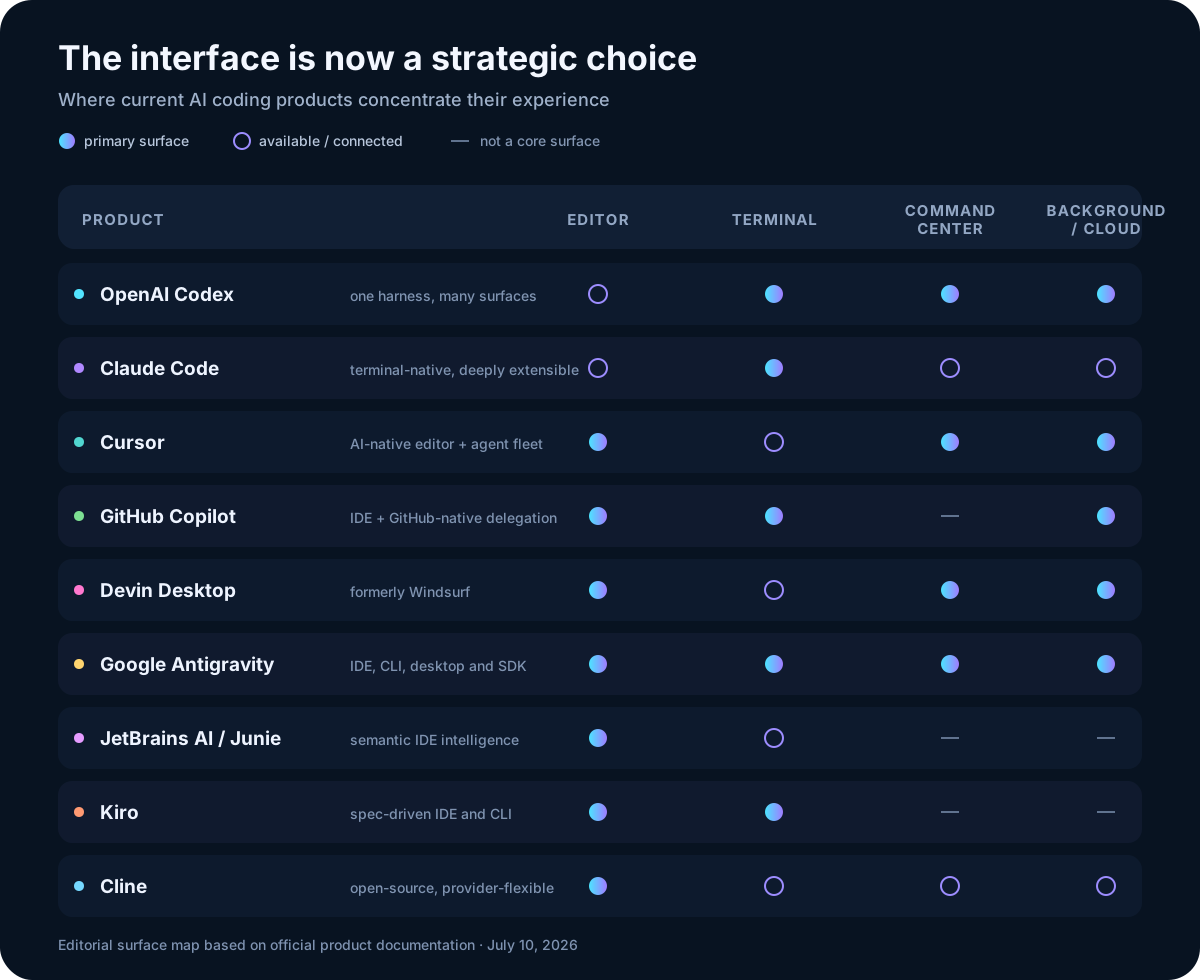
Model APIs are converging on similar primitives: long context, reasoning controls, tool calls, vision and structured output. Products differentiate through everything around those primitives: how they index a repository, isolate concurrent work, ask for permission, recover after a failing test, preserve team rules and present evidence for review.
OpenAI Codex: one agent across local and cloud work
Codex is no longer just a terminal program. It spans a desktop command center, CLI, IDE extension and hosted cloud tasks. The desktop app uses separate threads and Git worktrees so several agents can work in parallel without trampling the same checkout. Local surfaces use configurable sandboxing and approvals; cloud tasks run in isolated environments. Skills, MCP, hooks, automations, the SDK and GitHub Actions make it attractive when you want one harness from quick fixes to long-running delegated work.
Claude Code: the composable terminal specialist
Claude Code reads the repository, edits files, runs commands and works with Git, but its real strength is composability. CLAUDE.md, automatic memory, hooks, skills, MCP, custom subagents and the Agent SDK let teams turn conventions into repeatable behavior. The same engine now appears in terminals, VS Code and Cursor, JetBrains IDEs, Claude Desktop and the browser. If your workflow already lives in shell scripts and CI, Claude Code fits with very little ceremony.
Cursor: a strong editor-to-agent continuum
Cursor still offers the familiar tight edit-and-review loop, but it has expanded well beyond autocomplete. Local agents can search, edit, run commands and keep checkpoints. Cloud agents run in isolated VMs, install dependencies, test through computer use and return pull requests with logs, screenshots or video. The Agents Window adds worktrees, asynchronous subagents and local-to-cloud handoff. Pick Cursor when you want agents to feel native to the editor rather than bolted onto it.
GitHub Copilot: the GitHub-native delegation layer
Copilot now spans inline completion, IDE agent mode, CLI, code review and a cloud agent that works in an ephemeral GitHub Actions environment. It can start from an issue, plan, create a branch, change code, run tests and open a pull request. Repository instructions, custom agents, MCP, hooks, skills and public-preview Copilot Memory make it especially compelling for organizations whose source of truth is already GitHub.
Devin Desktop: Windsurf's multi-agent successor
Windsurf was renamed Devin Desktop on June 2. Its new center of gravity is an Agent Command Center that supervises local and cloud agents, with Spaces grouping sessions, files, worktrees and pull requests. Devin Local, a Rust rewrite, is now the primary successor to Cascade; Cognition said users could continue with legacy Cascade through July 1. Preview ACP support also lets Codex, Claude Agent, OpenCode, Devin and custom compatible agents share one interface. Existing Windsurf extensions and keybindings remain compatible.
Google Antigravity: Google's new agent-first platform
Antigravity 2.0 is the current Google platform to watch. It comes as a desktop command center, CLI, IDE and Python SDK, all built around the same runtime. It emphasizes multi-agent orchestration, subagents, browser and visual verification, and audit artifacts containing plans, changes and test evidence. On June 18, Google stopped serving individual and AI Pro/Ultra users through Gemini Code Assist IDE extensions and Gemini CLI, directing them to Antigravity. Managed Code Assist Standard and Enterprise remain.
JetBrains AI and Junie: semantic IDE intelligence
JetBrains increasingly acts as an agent-agnostic layer. AI Assistant can host Junie, Codex, Claude Agent, GitHub Copilot and external ACP-compatible agents. Junie remains the native option and can use IDE indexing, symbol-aware navigation and refactoring, existing run configurations and test runners. That deep semantic connection is a reason to consider it over a generic editor plugin. JetBrains currently recommends Codex as its default agent, but switching is part of the design.
Kiro: specifications as durable project artifacts
AWS stopped new Amazon Q Developer IDE account and subscription signups on May 15, 2026. Existing IDE-plugin customers remain supported until April 30, 2027, with AWS directing migrations to Kiro. Kiro's differentiator is not another chat panel. A feature spec produces reviewable requirements.md, design.md and tasks.md; a bug-fix spec uses bugfix.md in place of requirements.md. The IDE and CLI share those artifacts, alongside steering files, hooks, MCP and custom agents.
Cline: the open, provider-flexible counterpoint
Cline is an Apache 2.0 option spanning VS Code, JetBrains, CLI, headless CI, an agent board and an SDK. It can edit files, run commands, browse, use MCP and retain checkpoints while keeping human approval in the loop. It is not the only open agent harness, but it is a useful reminder that control over models, providers and permissions does not require buying into a vertically integrated stack.
3. Which stack should you choose?
| Your situation | Start here | Why | Watch for |
|---|---|---|---|
| Solo product engineer | Cursor + GPT-5.6 Sol or Claude Sonnet 5 | Fast editor loop with a path to cloud delegation. | Do not let convenience turn every tiny change into an opaque agent session. |
| Large refactor or migration | Codex or Claude Code + top reasoning tier | Long-horizon execution, tests, Git and explicit repository guidance. | Split the work into reviewable milestones and isolate concurrent agents. |
| GitHub-centric engineering org | GitHub Copilot cloud agent | Issue-to-branch-to-PR flow fits existing controls and review. | Keep repository instructions and CI authoritative. |
| JetBrains-heavy backend team | JetBrains AI with Junie or Codex | Uses IDE indexing, semantic navigation, run configurations and test runners. | Compare agents inside the same IDE before changing your whole toolchain. |
| Requirements-heavy product work | Kiro | Durable specs make scope and design inspectable before code is written. | Do not turn every trivial fix into a full documentation ceremony. |
| Self-hosted or provider-flexible | Cline + DeepSeek V4 or Qwen3.6-27B | Open harness and open weights maximize control. | Budget for inference operations, security patching and evaluation. |
| Google-centered environment | Antigravity | Google's current common runtime spans IDE, CLI, desktop and SDK. | Consumer and managed Code Assist availability now differs. |
| Multi-agent command center | Codex app or Devin Desktop | Both make concurrent agent work a first-class visual workflow. | Parallelism multiplies review load as quickly as output. |
4. The benchmark is not the job
Benchmarks test a slice of the system. Production engineering also depends on repository comprehension, tool reliability, permission boundaries, test quality, UI review, network access, retry behavior and the agent's willingness to stop when evidence is weak. A model that scores two points higher but produces sprawling diffs can cost more developer time than a slightly weaker model inside a disciplined harness.
Run a small internal evaluation instead. Pick ten real tasks from your own history: one bug with a reliable regression test, one cross-file refactor, one dependency upgrade, one UI change, one flaky test, one documentation task and several routine edits. Measure time to a passing result, human review minutes, unnecessary lines changed, rollback rate and total cost. This will tell you more than a leaderboard screenshot.
5. How to use agents without losing engineering control
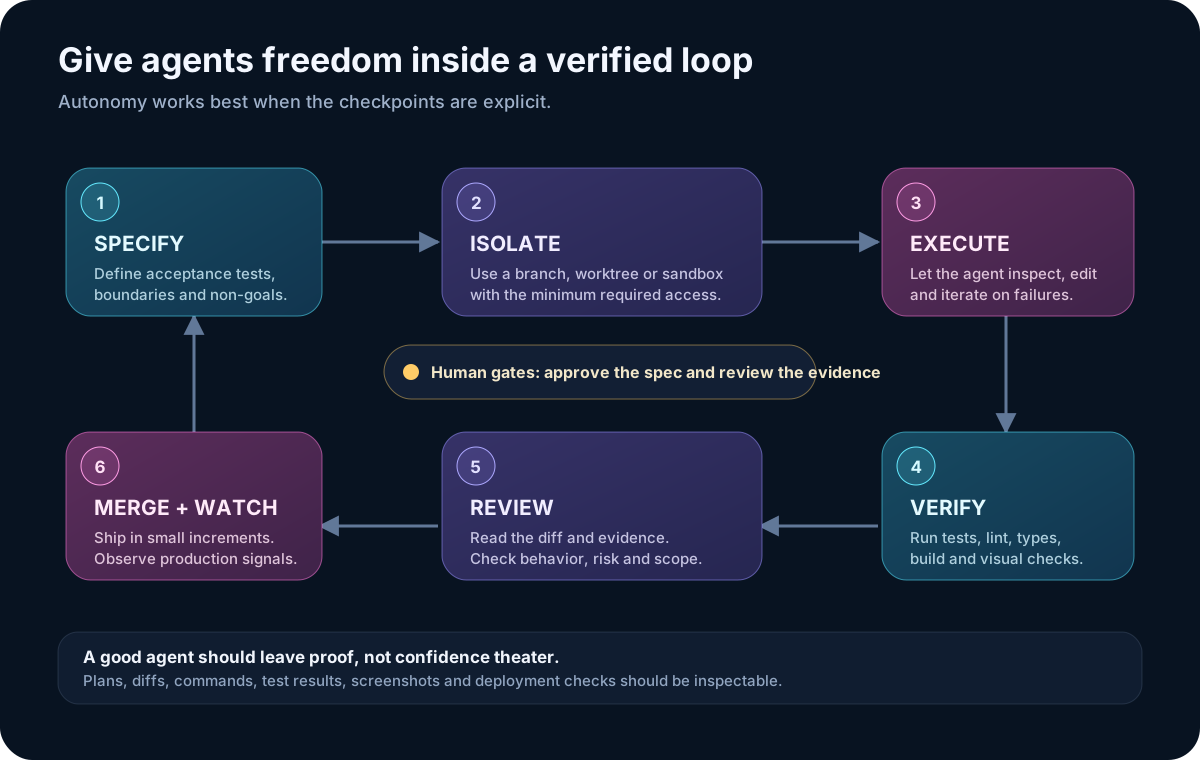
Give the agent observable behavior, non-goals and commands that define "done." A polished explanation is not a passing test.
Use a branch, worktree, container or cloud sandbox. Multiple agents in one checkout are an invitation to hidden coupling.
Tests, type checks, linters, builds, browser checks and screenshot-based visual checks should form an executable verification plan, not a list of aspirations.
Passing tests can still hide scope creep, security regressions and unnecessary complexity. Read what changed.
My practical recommendation for mid-2026
Choose a surface first, then a model. If you live in an editor, start with Cursor. If you live in Git and the terminal, try Claude Code or Codex. If work arrives as GitHub issues, test Copilot's cloud agent. If requirements and architecture matter more than speed, use Kiro. If you need model and provider control, pair Cline with DeepSeek V4 or Qwen3.6.
Then evaluate two models inside that same harness on your own tasks. The winner is not the one that writes the most code. It is the one that reaches a correct, minimal and reviewable result with the least human cleanup.
Official sources and methodology
Product names, availability and technical specifications were checked against official documentation on July 10, 2026. Benchmark values are vendor-reported and are presented with their benchmark version and caveats.
- OpenAI model catalog, GPT-5.6 general availability, GPT-5.3-Codex, Codex-Spark and Codex app.
- Anthropic model overview, Claude Fable 5, Claude Sonnet 5, Claude Opus 4.8 and Claude Code.
- Gemini 3.5 Flash, Antigravity surfaces and Code Assist availability.
- Grok 4.5 launch and model documentation.
- DeepSeek V4 release, Qwen3.6-27B, Mistral Medium 3.5 and its official model license.
- Cursor agents, GitHub Copilot features, Devin Desktop rename, JetBrains agents, Kiro, Amazon Q IDE transition and Cline.
This article is an editorial guide, not a sponsored ranking. Product availability, pricing and model aliases change quickly; verify them before committing a team or production workload.