
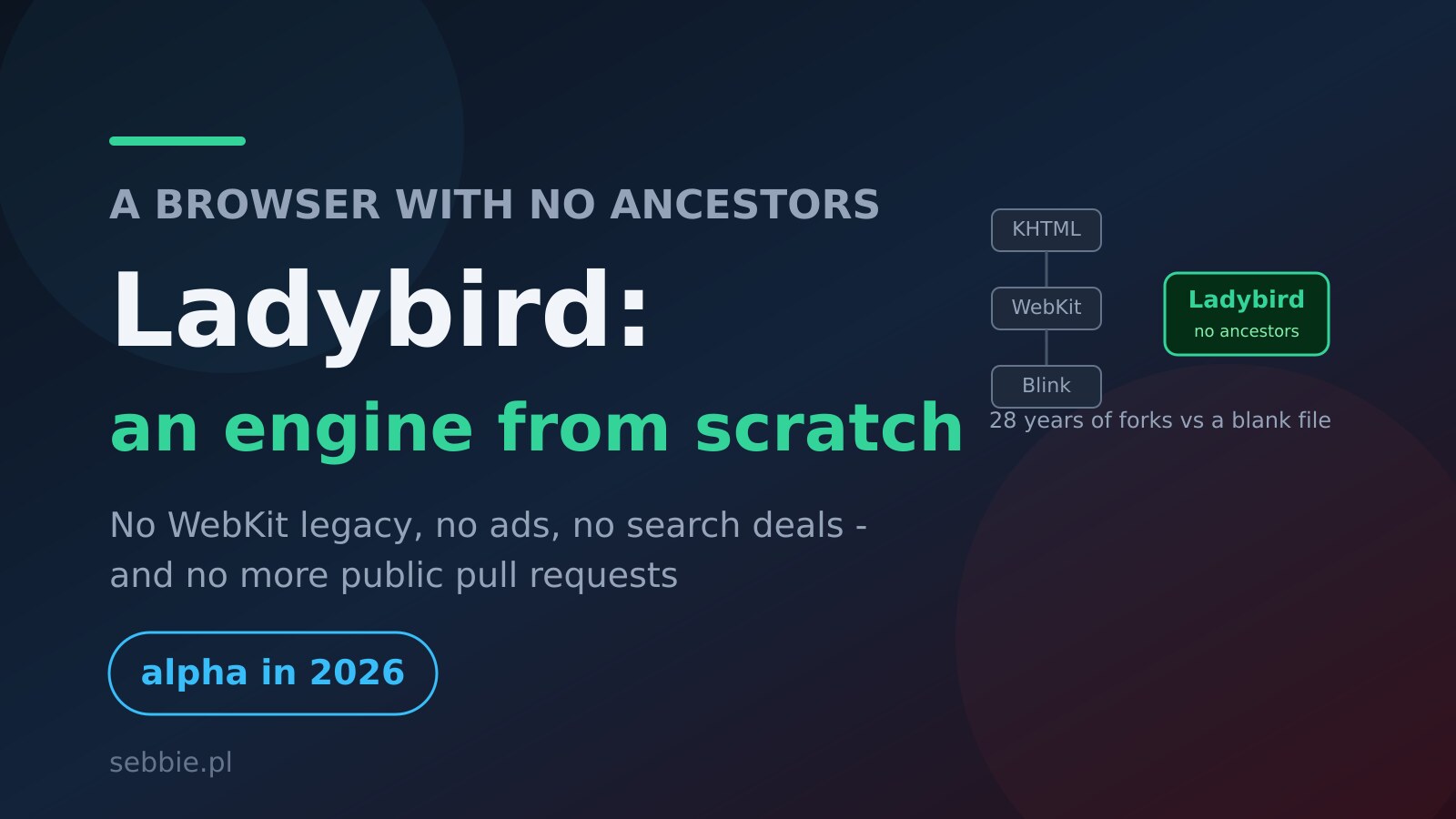
Every browser you have ever used is running on borrowed history. Chrome, Edge, Opera, Brave, Arc - all Blink, which is a fork of WebKit, which is a fork of KHTML, a rendering engine started in 1998. Safari is WebKit itself. Firefox runs Gecko, whose lineage reaches back to Netscape. Whatever logo sits in your dock, the code underneath carries a quarter century of accumulated decisions, workarounds and legacy nobody dares touch. Which is exactly why Ladybird fascinates me more than any other project in the browser world: Andreas Kling and a small team are writing a complete browser engine from scratch - not a fork, not a wrapper, every layer from HTML parsing to JavaScript execution built fresh against the modern specs. The first alpha is scheduled for this year, and in June the project made a decision that says a lot about where open source is heading in the AI era: it stopped accepting public pull requests entirely. Let me unpack both stories, because together they are one of the most interesting things happening in software right now.
Why "from scratch" is the whole point of Ladybird
To appreciate the ambition, you need to see how deep the monoculture goes. The web has effectively three engines left: Blink (Chrome and nearly everything else), WebKit (Safari, and Blink's ancestor), and Gecko (Firefox, market share in the single digits). Two of those three share DNA. Everything else - Edge's EdgeHTML, Opera's Presto - was abandoned years ago because keeping an engine competitive is one of the most expensive engineering undertakings in existence. The web platform is arguably the largest API surface humanity has ever specified: thousands of pages of living specs for HTML, CSS, JavaScript, WebAssembly, and hundreds of APIs from clipboard to WebGPU.
Ladybird's bet is that a clean-room implementation, written directly against today's specifications rather than against 1998's assumptions, is not just possible but structurally healthier. No quirks-mode archaeology, no vendor-prefix graveyards, no twenty-year-old performance hacks that nobody remembers the reason for. The engine consists of the project's own libraries for web rendering and JavaScript - with third-party code only for well-solved commodity problems like image, audio and video codecs, encryption and graphics. The codebase is C++, with Rust being adopted incrementally as its successor, according to the project's own site.
The guy writing it has done the impossible before
A word about why anyone takes this seriously at all, because "we will write a browser from scratch" is normally the punchline of a joke about scope. Andreas Kling is a former WebKit engineer at Apple - he has worked inside the engines he is now competing with. In 2018 he started SerenityOS, a from-scratch Unix-like operating system, as a personal recovery project, and turned it into one of the most beloved open source communities anywhere. Ladybird began around 2019 as SerenityOS's built-in web engine, became a standalone cross-platform browser project in 2022, and in July 2024 spun out into its own 501(c)(3) nonprofit, the Ladybird Browser Initiative, with GitHub co-founder Chris Wanstrath backing it with a million dollars.
The funding model is as radical as the code: donations and sponsorships only - no default search deals, no data collection, no ads, no crypto tokens. Sponsorship tiers run from 1,000 to 100,000 dollars, and the sponsor list includes Shopify, Cloudflare, FUTO and the Human Rights Foundation. Crucially, sponsorships are unrestricted - board seats and influence are explicitly not for sale. Compare that with the awkward fact that even Firefox, the flagship of browser independence, lives mostly off a search deal with Google. Ladybird is trying to prove a browser can exist with no monetization pipeline pointed at its users at all.
The roadmap is patient in a way that modern software rarely is: Alpha for Linux and macOS in 2026, beta in 2027, general stable release in 2028. Windows support later; mobile deferred. No growth hacking, no premature launch - just a decade-long climb toward a usable, independent browser.
June 2026: closing the door on public pull requests
Now the fresh news, and it is a remarkable piece of open source sociology. On June 5, 2026, Kling announced that Ladybird will no longer accept public pull requests. All open PRs were closed; going forward, code enters the browser only through project maintainers. Bug reports, testing, standards work and security reports remain welcome - but the era of drive-by patches is over, and forks, the announcement notes pointedly, will not be treated as review queues.
The stated reasons deserve quoting, because they capture something bigger than one project. The announcement observes that a substantial patch used to imply substantial effort, and that effort was a reasonable proxy for good faith - "that assumption no longer holds". AI tooling has made large, plausible-looking contributions nearly free to produce, which floods maintainers with review work while destroying the signal that effort once carried. And for a browser - a program whose entire job is executing untrusted input from the internet - the security stakes compound the problem. The team says it has already seen "patient, well-resourced campaigns" in open source aimed at earning maintainer trust and then abusing it; anyone who remembers the xz-utils backdoor knows this is not hypothetical paranoia.
I have mixed feelings about this and I think that is the correct emotional state. Something real is lost - the "anyone can fix a browser bug" story was one of open source's best recruitment pitches, and Ladybird itself was built by exactly such contributors, hundreds of them. But I find the reasoning honest in a way most AI-policy statements are not. This is the same dynamic I keep writing about from the other side: on this blog I celebrate agents that generate competent patches in minutes, and Ladybird is showing us the bill for that capability landing on maintainers of security-critical software. When patches are free, review becomes the scarce resource, and projects will reorganize around protecting it. Ladybird is simply early and explicit about it. Expect others to follow quietly.
Does the web need this browser?
An honest assessment, because I am rooting for this project and that is exactly when skepticism matters most. The case against: the web platform grows faster than any small team can chase it, the giants ship new APIs yearly, and history is littered with abandoned engines whose teams were far larger. Reaching "renders most sites correctly" is a mountain; reaching "daily driver" is a mountain range. The case for: the team has already gotten further than anyone predicted, passing enormous chunks of the web platform test suites and rendering real-world sites credibly - and they have done it with a fraction of the engineers and none of the legacy. Writing against modern specs turns out to be a genuine advantage: the specs of 2026 are extraordinarily detailed compared to the tribal knowledge era in which the incumbents grew up.
But the deeper argument is not about whether Ladybird beats Chrome. It is about what its existence does to the ecosystem. A web with one and a half engines is a web where the spec is whatever Chromium does - implementation details ossify into de facto standards, and standards bodies rubber-stamp reality. Just as I argued when writing about ES2026 and the TC39 process, the health of the web depends on specifications meaning something independent of any single implementation. Every independent engine is a proof that the spec, not the market leader's codebase, defines the platform. Even if Ladybird never takes meaningful market share, a fourth engine that passes the test suites keeps everyone else honest - and gives regulators, researchers and standards authors a reference point that is not controlled by an advertising company.
Summary: the most romantic project in software, now with doors
Ladybird is the kind of project that should not work: a from-scratch browser engine, funded by donations, refusing every monetization path the industry considers mandatory, on a roadmap measured in years - alpha this year on Linux and macOS, beta in 2027, stable in 2028. And yet it keeps advancing, led by someone who has already built an operating system from nothing. The June decision to end public pull requests makes it also a bellwether: the first high-profile project to formally acknowledge that AI-generated contributions have broken the old open source trust model, and to redesign its gates accordingly. I will be installing the alpha the day it ships. Not because it will replace my daily browser this year - it will not - but because some projects deserve to be used on principle, and a browser with no ancestors and no one to monetize me is very high on that list.