
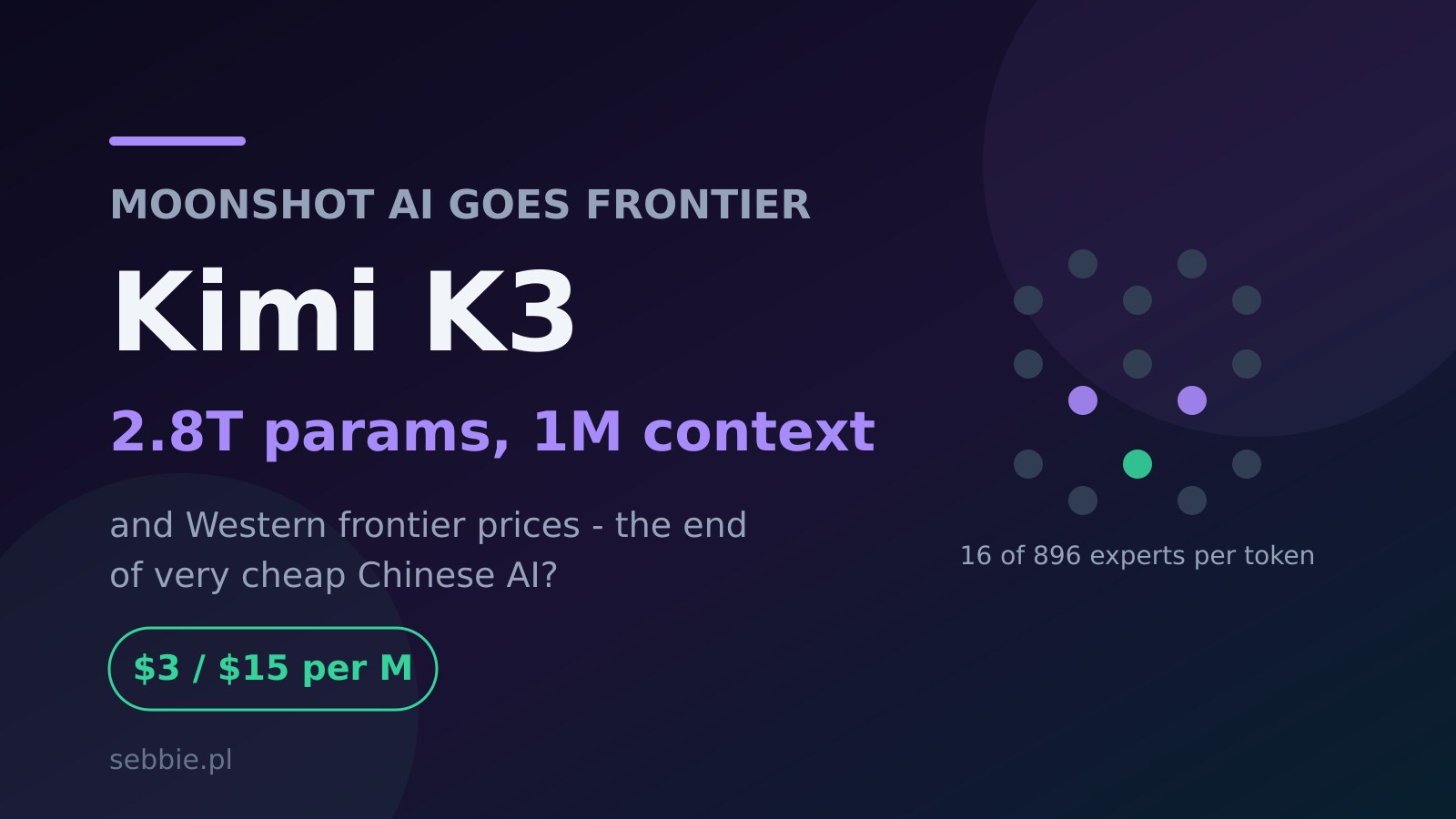
On July 16, Moonshot AI released Kimi K3, and for the first time in months a Chinese model launch made me put down my coffee and read the technical notes twice. The headline specs are almost cartoonish: 2.8 trillion parameters in a Mixture-of-Experts architecture, a 1,048,576-token context window, native multimodality across text, images and video, and benchmark claims that - by Moonshot's own admission - trail only the very best closed models from OpenAI and Anthropic. But the spec sheet is not actually the story. The story is the price list. Kimi K3 costs 3 dollars per million input tokens and 15 dollars per million output tokens - Western frontier pricing, from a Chinese lab that built its entire market position on being absurdly cheap. The era of bargain-basement Chinese AI may have just announced its own ending.
Kimi K3 in numbers
Let me get the concrete facts on the table first, because there are a lot of them:
- 2.8 trillion total parameters, Mixture-of-Experts, activating 16 of 896 experts per token - giant representational capacity at a fraction of the compute of a dense model this size.
- Context window of 1,048,576 tokens - four times the 256K of the K2.5-K2.7 line, eight times the 128K of the original K2.
- Native multimodality: text, images and video on input, no bolted-on encoders.
- Always-on reasoning with an adjustable reasoning_effort parameter - the same pattern Western frontier models converged on this year.
- Two launch variants: K3 Max for chat and agentic work, and K3 Swarm Max for massive parallel processing.
- Available now on Kimi.com, in Kimi Code, and through an OpenAI-SDK-compatible API. The weights are not out yet - promised by July 27.
The architecture is more interesting than the size
Parameter counts make headlines, but the two architectural changes Moonshot described in its technical materials matter more for anyone who will actually use this thing.
Kimi Delta Attention (KDA) is a hybrid linear attention mechanism that Moonshot claims delivers up to 6.3x faster decoding at contexts around a million tokens. This attacks the real problem with long context - which was never whether a model can hold a million tokens, but how long you wait (and how much you pay) for it to do anything useful with them. If the claim survives contact with production traffic, long context stops being a marketing bullet and becomes a daily tool for working with large codebases.
Attention Residuals (AttnRes) lets the model selectively reach back to representations from earlier network layers. Moonshot reports roughly 25% better training efficiency at less than 2% extra cost. That sounds like a footnote until you do the arithmetic: at this scale, a quarter improvement in training efficiency is tens of millions of dollars off the GPU bill - and a hint at how Chinese labs keep shipping frontier-scale models despite constrained compute access.
Benchmarks: Moonshot's table versus independent measurements
Moonshot published the usual launch-day results table, and the numbers are striking: 93.5 on GPQA-Diamond, 91.2 on BrowseComp, 88.3 on Terminal-Bench 2.1, 81.2 on FrontierSWE. To the company's credit, it also openly concedes that K3 still trails Claude Fable 5 and GPT-5.6 Sol overall - the claim is "best of the rest", not "new king".
But here is the rule I repeat with every launch: a vendor's table is not an independent evaluation. The first external measurements are in, and they show the familiar pattern. The evaluation platform Vals measures K3 at 80.9 on Terminal-Bench 2.1 against Moonshot's claimed 88.3 - a 7.4-point gap. Artificial Analysis scores it 57.11 on its Intelligence Index and 76.24 on its coding index. These are still excellent numbers for anything, let alone a model promising open weights. Just calibrate accordingly before you rewire any production workflow.
The end of very cheap Chinese AI
Now the part that genuinely surprised me. For the past year, Chinese open-weight models competed primarily on price - I documented the result in my piece on how Chinese open-weight models came to grind through nearly half the tokens in American APIs. Kimi K3 visibly corrects that strategy. The official API rates: 0.30 dollars per million cached input tokens, 3 dollars per million uncached input tokens, 15 dollars per million output tokens.
Compare that with the GPT-5.6 pricing I broke down in my post on the Sol, Terra and Luna launch: Sol costs 5/30, Terra 2.50/15. Kimi K3 sits almost exactly on top of Terra. This is no longer "ten times cheaper than the West" - this is a lab pricing its model like a peer, because it believes the model is a peer. The Decoder called the launch a signal that the super-cheap Chinese AI era is ending, and the logic is hard to argue with: when you genuinely approach the frontier, you stop subsidizing every token just to get anyone's attention.
For developers this cuts both ways. The good news: competition is now about quality, not just cost, and that is the competition that improves your tools. The bad news: if you built cheap pipelines on dumping-era Chinese API prices - and plenty of us did - those economics have a shelf life. One practical note from the price list: the 10x gap between cached (0.30) and uncached (3.00) input means prompt architecture with a stable prefix - fixed system prompt, fixed repository context - is no longer an optimization for purists. At a million tokens of context, cache discipline is the difference between a reasonable bill and a catastrophe.
About those weights
One thing needs naming plainly: Moonshot markets K3 as open-weight, but on launch day no weights were published. The promise is "by July 27". Until then, K3 is functionally a closed model with an IOU attached - usable through the API, but not inspectable, not fine-tunable, not self-hostable.
I am moderately optimistic the promise gets kept, because the track record says so. Moonshot published weights for the whole K2 family, and that openness had real consequences: Kimi K2.7 Code went from weight release to the official GitHub Copilot model list in a record 19 days - a story I covered in my post on open-weight models entering Copilot. If the K3 weights land on Hugging Face on schedule, the same dynamic kicks in at a much larger scale. Realism check, though: at 2.8 trillion parameters, "open weights" does not mean you will run this at home. It means auditability, fine-tuning for large players, and third-party hosting competition - which is what actually pushes API prices down.
Markets flinched, again
The launch also moved money. AI and semiconductor stocks dipped noticeably, and financial media from Bloomberg to Axios reached for the same comparison: the "DeepSeek moment" of January 2025, when a single Chinese release briefly shook the entire sector's valuations. I would not overstretch the analogy - markets have had eighteen months to learn that strong Chinese models are the norm, not an anomaly - but the direction is clear. Investors increasingly price in a world where the American labs' lead is measured in months, not years.
One more number tells you what that world costs. According to TechCrunch, Moonshot is raising a new round at a 31.5 billion dollar valuation - up from 20 billion in May. A greater than 50% jump in half a year is what a seat in the first league goes for now. And every one of those dollars ultimately queues up for the same constrained compute I wrote about in yesterday's TSMC earnings post.
How I would actually test it
If you want to evaluate Kimi K3 for real work rather than vibes, my suggestions after years of doing this with every major release:
- Start with the API, not the chat. It is OpenAI-SDK-compatible, so in most projects switching is a base URL and a key - fifteen minutes, not a migration.
- Test the long context specifically, because that is the novel part. Load a mid-sized repository - a few hundred thousand tokens - and ask cross-cutting questions. Measure time to first token as well as quality; that verifies the KDA claims faster than any benchmark.
- Model your costs with cache, not without. See above - at this context size, the 0.30 versus 3.00 distinction dominates everything.
- Compare against what you actually use today, not against the vendor table. My standing test set is the same three tasks every time: a refactor with tests, a debugging session from logs, and a pull request review.
And give it a week or two before final judgment - launch-week APIs are overloaded and rate-limited, which distorts every impression of speed.
Summary: the price tag is the headline
Kimi K3 is a genuinely impressive artifact: 2.8 trillion parameters, a million tokens of usable context, novel attention mechanisms, and benchmark results that - even at the deflated independent numbers - put it at the top of the open-weight class the moment the weights actually ship. But the most consequential number in the whole release is 15 dollars per million output tokens. A Chinese lab looked at the Western frontier price sheet and matched it, because it believes it belongs in that bracket. Whether the belief is fully justified we will know by early August, once the weights are out and independent evaluations mature. Either way, the subsidized era is closing - and the AI market just got more honest, and more expensive, at the same time.