
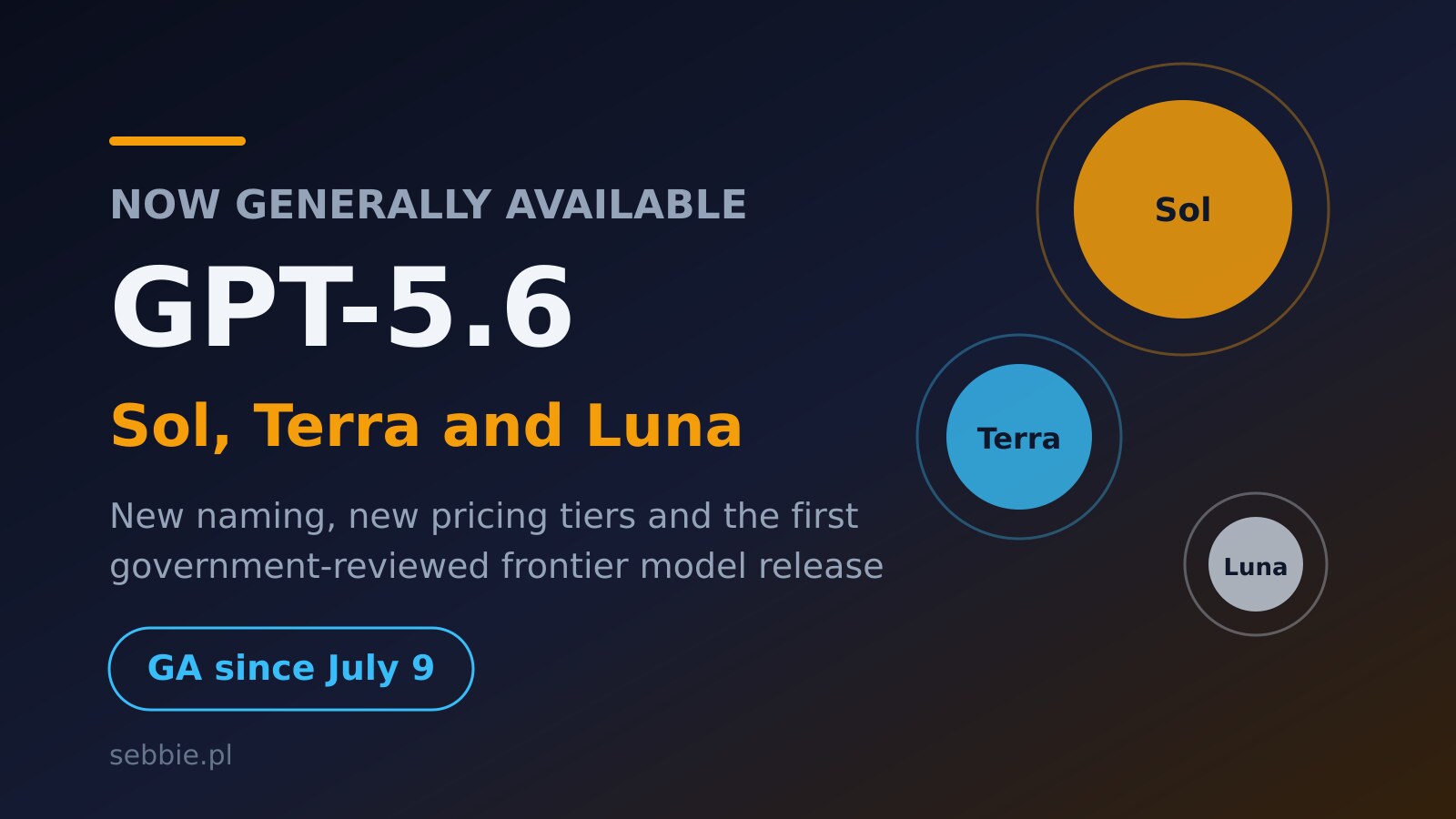
For a release that OpenAI itself calls "an access story, not a benchmark story", GPT-5.6 has managed to change a surprising number of things at once: how OpenAI names its models, how much serious agentic work costs, and - in a first for the industry - how a frontier model gets cleared for release by a government before the public ever touches it. The family went generally available on July 9, 2026 across ChatGPT, Codex and the API, after a two-week invite-only preview that started June 26. I have spent the past week reading the docs, the pricing tables and the fine print, and I think GPT-5.6 is best understood not as one model but as a statement about how OpenAI wants us to buy intelligence from now on.
Sol, Terra, Luna: the naming system actually matters
Let us start with the thing everyone noticed first. GPT-5.6 is not a single model - it is three: Sol, Terra and Luna. In the new scheme, the number identifies a model generation, while the celestial names identify durable capability tiers that can advance on their own cadence:
- Sol is the flagship for the hardest work. The bare "gpt-5.6" API alias routes to it.
- Terra targets GPT-5.5-class quality at roughly half the price - the workhorse tier.
- Luna is the fastest and cheapest, aimed at high-volume, latency-sensitive tasks.
This sounds like marketing until you think about what it fixes. Under the old scheme, every release forced you to re-learn the lineup: was mini above or below the previous full model? Is 5.5 cheaper than 5.1-turbo? The new grid - generations move horizontally, tiers stay put vertically - means that when GPT-5.7 arrives, "Terra" will still mean "the balanced one" and your mental model survives the upgrade. Anthropic has been doing something similar with its tiers for years, and OpenAI adopting the pattern tells you it works.
What is actually new under the hood
OpenAI published relatively few headline benchmarks with this release, which is itself informative. The numbers that did surface: Sol scores 52.7% on Agents Last Exam, a 5.8-point jump over GPT-5.5, and leads on computer-use tasks. At the same time, Claude models still hold the lead on SWE-Bench Pro, GDPval Elo and HealthBench Professional. In other words: nobody swept the board, and the frontier remains split by workload - a theme I keep returning to in my overview of the AI coding stack in 2026.
The genuinely new capabilities are agentic plumbing rather than raw intelligence:
- Programmatic Tool Calling. Instead of emitting one JSON tool call at a time, the model can write JavaScript that runs in an isolated V8 runtime and orchestrates tools in code - loops, conditionals, batching. For anyone who has burned tokens watching a model call the same tool forty times in sequence, this is the big one.
- Multi-agent coordination in the Responses API. First-class support for models spawning and coordinating sub-agents, rather than developers duct-taping it together.
- Persistent reasoning across turns. The model retains its reasoning state between conversation turns instead of rebuilding it, which should cut both latency and cost in long agentic sessions.
- Ultra mode. A setting that runs multiple agents - four by default - across parallel workstreams. OpenAI is refreshingly honest that it "increases token consumption by design": you are buying wall-clock speed with tokens.
Notice the pattern: every one of these features assumes the model is the engine inside a long-running agent, not a chatbot answering a question. The industry's direction of travel could not be clearer - it is the same current that produced the Codex Micro keypad, a physical device whose entire purpose is supervising parallel agents.
The government preview: a quiet precedent
Here is the part of the release I find most historically interesting, and it got the least attention. The June 26 preview was not just an ordinary staged rollout - it happened at the request of the US government, because of the model's cyber capabilities. On ExploitBench, an offensive-security evaluation, GPT-5.6 Sol jumped to 73.5% from GPT-5.5's 47.9%. That is not an incremental gain; that is a model crossing into territory where a state actor wants a look before general release.
So for roughly two weeks, about 20 approved partners and government evaluators had GPT-5.6 while the rest of the world did not. Whatever you think of the arrangement - and I have mixed feelings, since "the government previews powerful software before citizens get it" is a sentence with an uncomfortable aftertaste - it establishes a template. Frontier releases now have a de facto regulatory checkpoint in the US, informal but real. Combined with what I wrote about generative AI entering Secret and Top Secret networks, the entanglement between Washington and the frontier labs is tightening quarter by quarter, without any single law being passed.
What it costs in practice
The pricing table looks tame - Sol at 5/30 dollars per million tokens is close to what flagships have cost for a year - but the interesting economics live one level down. Terra at 2.50/15 claims GPT-5.5-class quality at roughly half the price. If that holds in your workloads, the rational move for most production systems is Terra by default, Sol on escalation, and that is exactly the routing pattern OpenAI's own tooling encourages.
Two fine-print details deserve attention. Cache writes now cost 1.25x the input rate (reads keep their 90% discount), which slightly penalizes naive agent loops that re-write huge contexts every turn. And Ultra mode's four-parallel-agents default means a single "do this task" click can consume tokens at four times the rate you budgeted. The honest framing - which, credit where due, OpenAI itself uses - is to measure cost per finished task, not price per token. A model that costs twice as much per token but finishes in one attempt instead of three is the cheaper model.
Plan-wise, the rollout is generous in one specific direction: Codex gets everything. Even lower ChatGPT tiers get Terra in Codex, while the free chat tier gets nothing at all. Developers are the audience OpenAI is least willing to lose - unsurprising when Zhipu, Moonshot and the rest of the open-weight wave keep shipping credible alternatives at aggressive prices.
Which tier for which job: my working defaults
Since half the questions I get about releases like this boil down to "so which one do I actually use", here are the defaults I have settled on after a week of testing across my own projects:
- Luna for anything high-volume and structured. Classification, extraction, routing, summarizing tickets, generating test data. At 1/6 dollars per million tokens it is cheap enough that you stop thinking about cost, and for narrow tasks the quality gap versus Terra rarely shows up in outputs.
- Terra as the production default. If it really delivers GPT-5.5-class quality at half the price, most agent workloads - code review passes, documentation generation, routine feature work - belong here. Set it as the default model and let escalation be the exception, not the rule.
- Sol for the hard 10%. Gnarly debugging, architecture decisions, long multi-step agent runs where one wrong turn early poisons everything downstream. This is also where persistent reasoning across turns pays for itself - the expensive model gets cheaper the longer the session runs.
- Ultra mode only with a budget cap. Four parallel agents by default means four parallel bills. It is genuinely useful for time-boxed sprints on a deadline, but treat it like a taxi meter that is always running.
The meta-advice: instrument before you optimize. Log cost per completed task per tier for your actual workloads for a week, then set routing rules. Every pricing intuition I had from the GPT-5.5 era turned out to be wrong somewhere once I measured.
My take after a week
GPT-5.6 will not be remembered for a benchmark. It will be remembered, I suspect, for three quieter things. The naming grid, which finally makes the product line legible and which competitors will feel pressure to mirror. Programmatic Tool Calling, which moves agent orchestration from prompt engineering into actual code and will quietly become the default way serious agents are built. And the government preview window, which happened once and will therefore happen again - precedents in AI governance only move in one direction.
The through-line is maturity. Nothing in this release tries to wow you; everything in it tries to make the existing agentic workflow cheaper, more controllable and more institutionally palatable. Eighteen months ago model launches were fireworks shows. Now they look like infrastructure upgrades with change-management notes. I mean that as a compliment - mostly.
Sources: OpenAI, Digital Applied.