
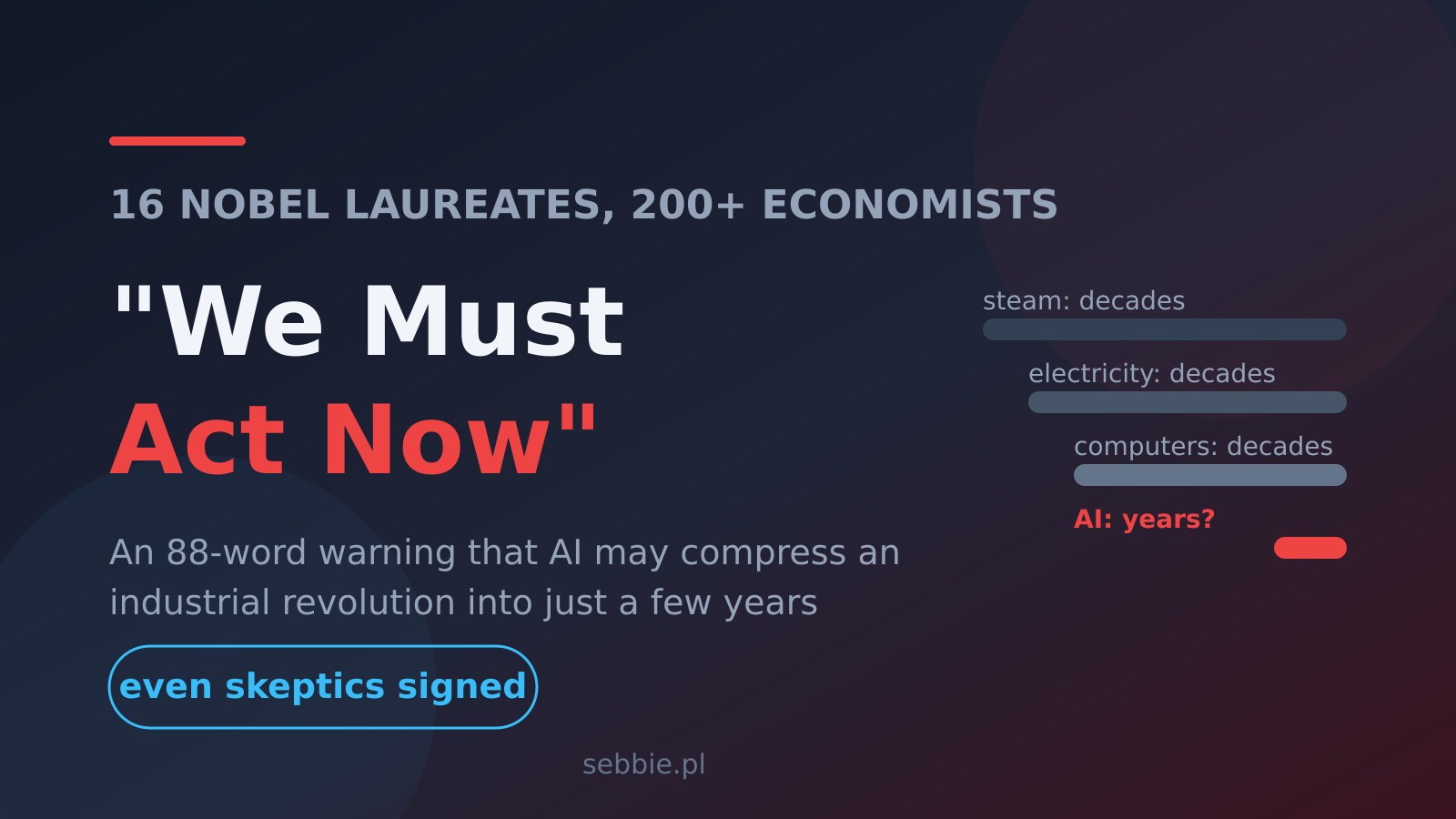
Eighty-eight words. That is the entire length of "We Must Act Now", the statement published on July 13, 2026 by the Stanford Digital Economy Lab and signed by more than 200 economists and AI researchers, including 16 Nobel laureates. I have read a lot of AI open letters over the past few years - pause letters, extinction letters, safety letters - and my default reaction has become a shrug. This one is different, and the difference is not the text. It is the signatures. When the people who spent a decade telling everyone to calm down about AI and jobs put their names under the words "we must act now", something in the expert consensus has genuinely shifted.
What the We Must Act Now statement says
The statement itself is deliberately spare. Its core claims, in plain terms:
- AI may become radically more powerful over the next 10 years.
- This could drive an economic transformation larger than the Industrial Revolution, but unfolding over a vastly shorter time frame.
- The risks include large-scale job displacement; the opportunities include major gains in living standards.
- Economists, policymakers and technology leaders should deepen research on AI's economic impacts now, and start building the policies and institutions needed so AI complements human capabilities rather than simply replacing them.
That is essentially all of it. No specific policy demands, no moratorium calls, no predictions with decimal points. The organizers - Erik Brynjolfsson (Stanford), Ajay Agrawal (University of Toronto), Anton Korinek (University of Virginia) and Tom Cunningham (METR) - clearly optimized for the widest possible coalition, and the brevity is the strategy: it is hard to refuse to sign a statement that mostly says "this is big, let us prepare".
Korinek's accompanying quote is the sharpest framing of the problem I have seen: steam, electricity and computers each gave societies decades to adapt; AI may give us only a few years. The claim is not that AI is worse than previous technologies. It is that the adaptation clock is shorter than the institutional clock, and that gap is where the damage happens.
The converts are the story
Open letters live or die by who signs them, and this is where "We Must Act Now" earns attention. Among the signatories are Daron Acemoglu and Simon Johnson, the MIT professors who shared the 2024 Nobel Prize in economics. If you have followed the AI-and-labor debate at all, you know why that matters: Acemoglu spent years as the most prominent academic skeptic of AI displacement hype. He is the economist who estimated AI's productivity effects would be modest, who argued the technology was overhyped and underdelivering, who pushed back - publicly and repeatedly - against exactly the kind of alarm this letter now raises. Michael Spence, another Nobel laureate signatory, adds further weight from the growth-economics mainstream.
When the designated skeptics co-sign the warning, one of two things has happened: either they have seen evidence that moved them, or the social cost of skepticism has flipped. Probably some of both. The evidence side is not hard to reconstruct - two years of agentic AI going from demos to deployment, entry-level white-collar hiring visibly softening in exposed occupations, and capability curves that keep refusing to flatten. I write about the tools side of this every week on this blog; the same systems I cover in my AI coding stack overview are what turned labor economists' spreadsheets from theoretical to empirical.
Brynjolfsson's line accompanying the launch - that AI capabilities are advancing far faster than our understanding of the economic implications, and that in that gap lie the greatest opportunities of our era - is characteristically optimistic in framing. But notice what even the optimist's version concedes: the gap is real, and it is widening.
What "act now" would actually mean
The letter conspicuously avoids policy specifics, so let me fill in what the signatories' own research programs suggest they have in mind. Reading Brynjolfsson, Korinek and Agrawal's recent work, the agenda clusters around four things:
- Measurement first. We currently track AI's labor effects with surveys designed for a slower economy. You cannot manage a transition you measure with a two-year lag - expect pushes for real-time labor market data, occupation-level exposure indices and systematic tracking of AI adoption inside firms.
- Complement, not substitute. Acemoglu's long-standing theme: technology's effect on workers is a design choice, shaped by taxes, incentives and defaults. Policy can favor AI that augments human work over AI that merely automates it - through procurement, R&D incentives and how labor versus capital is taxed.
- Transition infrastructure. Retraining that actually works, portable benefits, income-smoothing mechanisms for displaced workers. The honest version of this conversation admits nobody has built retraining programs at the scale a compressed transition would need.
- Distribution of gains. If the upside is "major gains in living standards", the institutional question is who captures them. This is where ideas like sovereign AI funds and public stakes in AI companies - which have moved from academic papers into actual policy discussions this year - connect to the letter's agenda.
None of this is exotic. That is rather the point: the signatories are not asking for anything technically hard. They are asking for institutions to start moving before the disruption arrives rather than after, which history suggests is exactly what institutions are worst at.
My skeptical reading, and why I signed on mentally anyway
Let me steelman the shrug. Open letters change nothing by themselves; the 2023 pause letter paused nothing. An 88-word statement vague enough for 200 people to sign is vague enough to justify almost any policy, or none. And economists as a profession have a poor track record of forecasting technological unemployment - they have predicted roughly none of the past zero mass displacements, as the joke goes. Anyone treating this letter as proof that mass job loss is imminent is reading more than the text says: it says "may", "could", "risks" - probabilities, not prophecies.
But here is why I take it seriously anyway. The letter is not a forecast; it is an insurance argument. The cost of preparing for a transition that arrives slowly is small - better data, better retraining, some institutional homework. The cost of not preparing for one that arrives fast is enormous and concentrated on the people least able to absorb it. When the experts who disagree about everything else - optimists like Brynjolfsson, pessimists like Acemoglu - converge on "buy the insurance", the rational response is not to debate whose forecast is right. It is to buy the insurance.
I sit inside this transition professionally. The agents I write about - the ones getting dedicated hardware for parallel orchestration - are precisely the systems whose economic footprint the letter worries about. From where I sit, the capability curve looks real, the adoption curve looks real, and the institutional response looks like a committee that has not scheduled its first meeting. Eighty-eight words will not fix that. But they move the Overton window in the one community - mainstream economics - whose blessing policymakers actually wait for. That is worth something.
Summary: the consensus moved
"We Must Act Now" is short, vague and non-binding, and it is still the most significant AI open letter in three years - because of who signed it, not what it says. Sixteen Nobel laureates, including the field's loudest displacement skeptics, now publicly agree that AI could compress an Industrial-Revolution-scale transformation into a few years, and that our institutions are not ready. The argument about whether this is worth preparing for is effectively over among the people who study it. What remains is the harder question the letter pointedly does not answer: whether anyone with actual power will act while "now" is still now.
Sources: Stanford Digital Economy Lab, The Hill.